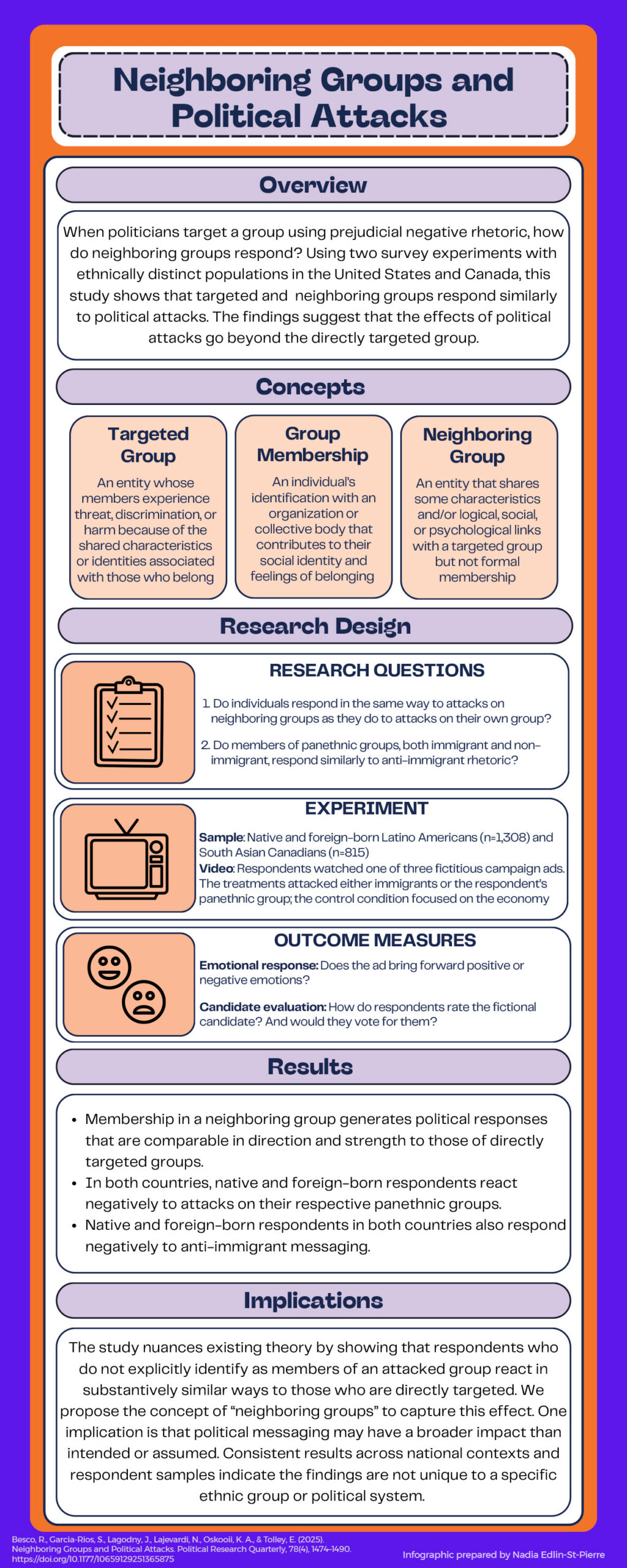

Explicit racism in political campaigns is rising, and some politicians now openly disparage immigrant, racial, and religious minorities. How do individuals respond to these attacks? Some research suggests people react more strongly to attacks on their own group, but what if the attack is directed toward a group that an individual does not belong to, but with which they share a logical, social, or psychological connection? We call these “neighboring” groups. Using survey experiments with immigrant and non-immigrant Latino Americans and South Asian Canadians, we measure the effect of exposure to campaign videos that disparage immigrants or Latinos/South Asians.
We find that members of neighboring groups report emotions and candidate evaluations that are very similar to those of directly targeted groups. These results point to the importance of neighboring groups and suggest that social and psychological connections can produce politically relevant effects as large as actual group membership.
Citation:
Randy Besco, Sergio Gracia-Rios, Julius Lagodny, Nazita Lajevardi, Kassra AR Oskooii, and Erin Tolley. 2025. Neigboring Groups and Political Attacks. Political Research Quarterly 78(4): 1474-1490. https://doi.org/10.1177/10659129251365875